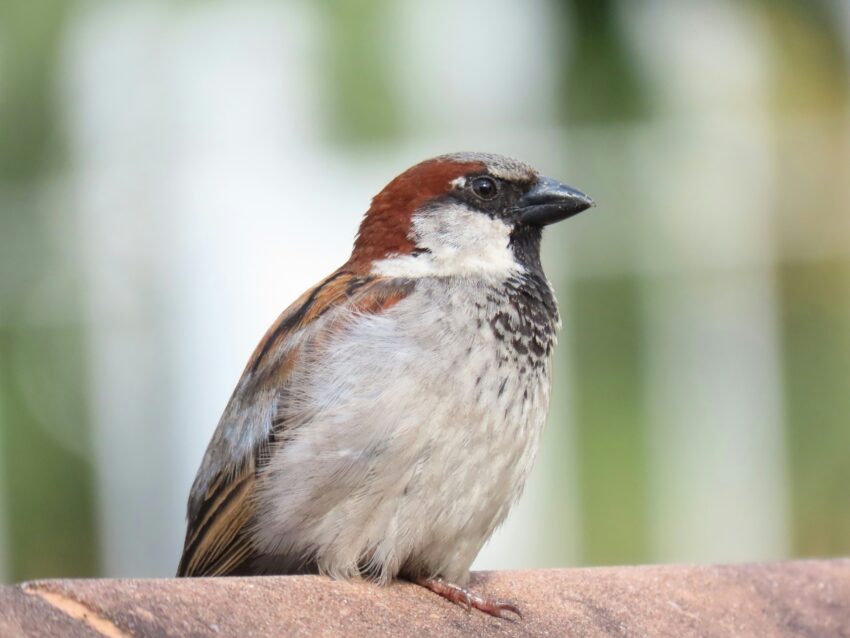
The ubiquitous and friendly House Sparrow is a non-native all-seasons resident in Nutley’s wildlife neighborhoods. Their songs are simple “cheep cheep cheep” and are easy to spot. They are relatively harmless small birds that are sexually dimorphic. The females have cute faces, pale eyebrows, tan and soft buffy brown plumage with striped brown back. Males sport a black mask and bib, gray crown, chestnut neck, brown wings, and tan to light brown belly. They can be found calling out their simple songs in wild natural spaces, as well as human structures such as roofs, utility wires, and business signs.
While they’re considered to be Old World sparrows, they aren’t closely related to their neighboring species of Song Sparrows or White-throated Sparrows. House Sparrows are small but mighty, about 5.9–6.7 inches long and roughly 0.9–1.1 ounces. They’re similarly sized to Song Sparrows, but have stockier bodies with rounder heads and shorter tails.
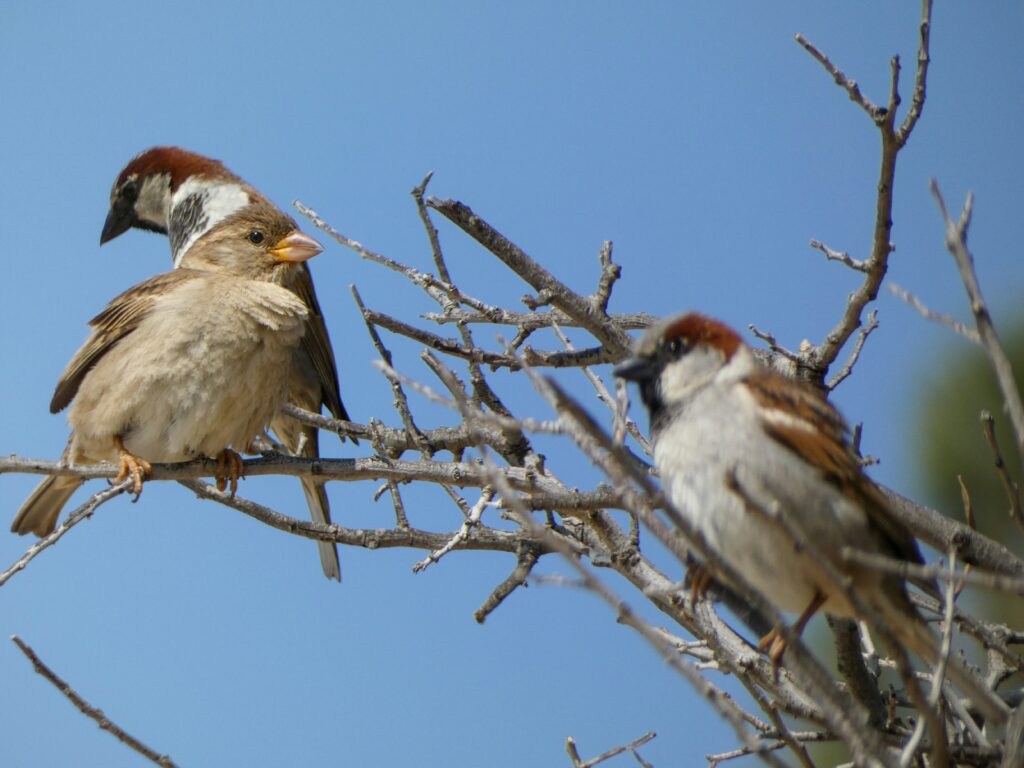
House Sparrows can be found hopping around foraging for seeds and grains together in grassy lawns and parks, as well as accepting human food crumbs. However, they will feed their babies a diet of insects during their breeding season in the summer. They can build nests in a variety of spaces in close proximity to humans, and can be found nesting near parking lots, streetlights, shop signs, roofs, restaurants, and awnings. They generally aren’t as commonly found nesting in forests or grasslands.
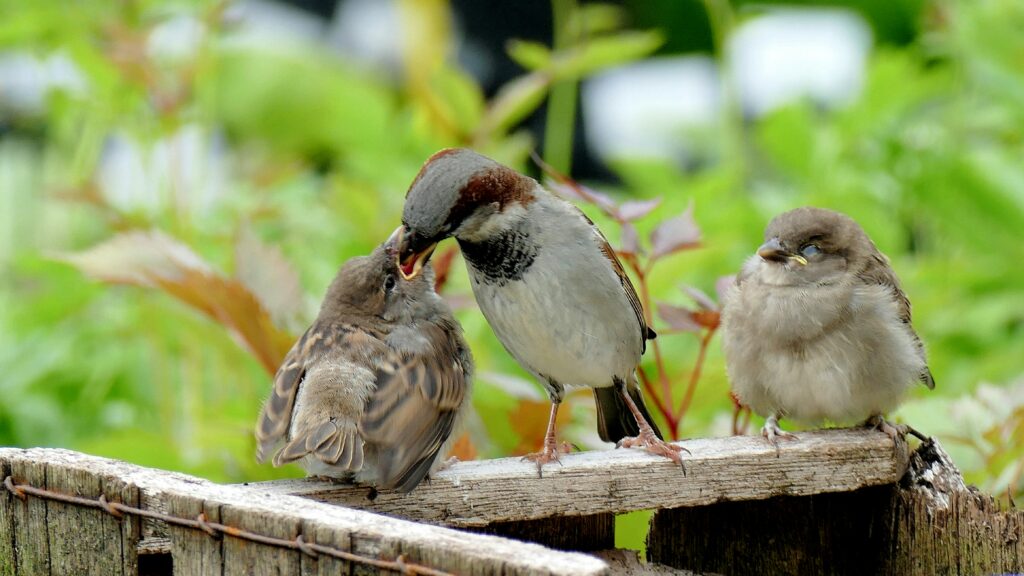
Many factors affect the statistics of their nests and number of eggs, but they do have typically expected statistics. A typical clutch consists of about 3–6 eggs, although they can possibly lay a range of 1–8 eggs. Their eggs are pale white in color with hues of green and blue. Both parents incubate their eggs for about 10–14 days, and both parents take turns feeding their young.
House Sparrows are an altricial species, whereas their hatchlings are born underdeveloped, commonly with closed eyes, and featherless. House Sparrow parents can raise multiple broods each year during breeding season. Juveniles can resemble an adult female, but recent fledglings will open their mouth begging for food with a yellow beak, also known as a gape.
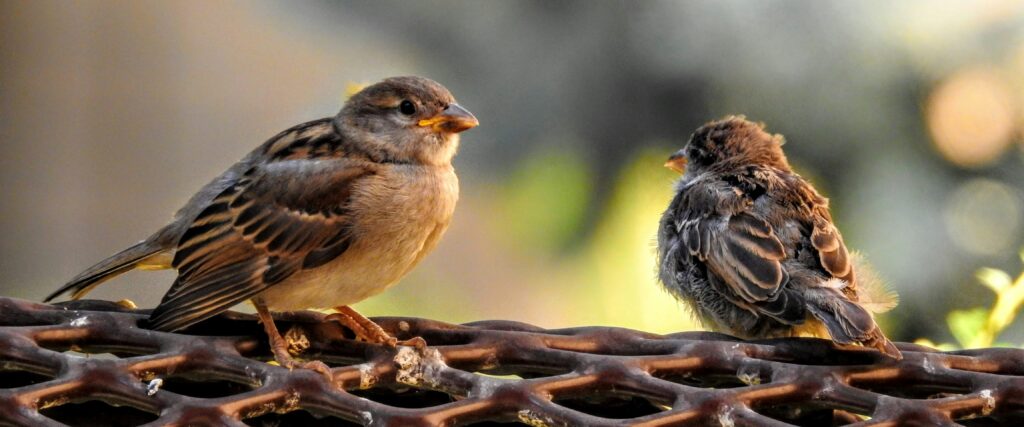
Their nests are delightfully messy: coarse, dry plants are stuffed into their nook and then lined with softer materials for a cozier fit for their nests. House Sparrows return to their nests with feathers, string, paper, and other chosen materials for added comfortable. They keep their neighbors close, and can sometimes build nests next to others. House Sparrow parents often reuse their nests for future egg clutches.
They choose to nest in cavities and boxes, and can be competitive with native bird species for these spaces. This is an unintended ecological impact resulting from being an invasive species, as they were introduced to North America by humans intentionally. House Sparrows were deliberately set free in New York City in 1851 and multiplied their numbers. During their time in North America, one study found geographic differences in their size and appearance ever since their introduction.
House Sparrows are considered a common bird in cities and towns, but their numbers have decreased since their population peaked around 1900. House Sparrows have adapted remarkably to their displacement from Eurasia and northern Africa to North America by adapting and surviving in new climates and habitats.
Species name: Passer domesticus
Sources: Audubon Society, Cornell Lab of Ornithology, National Library of Medicine
Photo credit: Önder Andinç on Unsplash